


Why Coastal Dunes Are Florida's First Line of Defense
A Guide for Treasure Coast visitors and Newcomers
There's a reason the first thing you notice when you arrive at a Treasure Coast beach isn't the ocean — it's the wall of sand, sea oats, and scrubby vegetation that stands between the parking lot and the waves. Those are the dunes. And they're doing a lot more work than they look like.
If you're new to Florida's coastline, coastal dunes might seem like a scenic backdrop — a nice place to snap a photo before you hit the water. But for the communities of Martin, St. Lucie, and Indian River counties, dunes are infrastructure. They are the coast's natural seawall, wildlife corridor, and storm shield, all rolled into one.
What Coastal Dunes Really Are

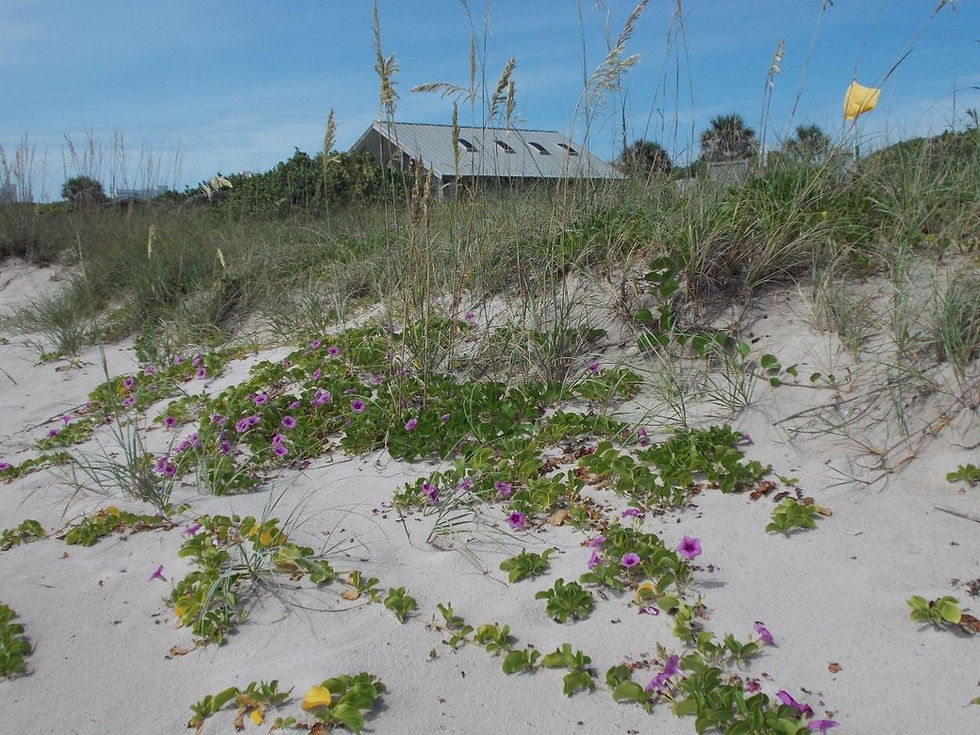
Coastal dunes form when wind carries dry sand inland from the beach and deposits it around anchoring plants. On the Treasure Coast, the most important of these plants is sea oats (Uniola paniculata) — the tall, golden-plumed grass you'll see swaying along nearly every natural beach here. Sea oats send deep, spreading root systems through the sand, binding it in place and allowing the dune to grow and stabilize over time.
What looks like a gentle hill is actually a complex, layered ecosystem. From the beach face to the inland scrub, dunes support distinct communities of plants adapted to salt spray, intense sun, and shifting sand — including beach morning glory, railroad vine, saw palmetto, and sand live oak. These plants, in turn, provide habitat for gopher tortoises, dune lizards, nesting shorebirds, and a remarkable variety of native pollinators.
Dunes perform critical functions that directly affect the safety and ecology of the Treasure Coast
Storm and erosion protection. Dunes act as a physical buffer between the ocean and inland communities. During hurricanes and storm surges, a healthy dune system absorbs wave energy and slows flooding. When dunes are degraded or missing, storm damage to homes, roads, and infrastructure increases dramatically.
Freshwater and groundwater protection. Dunes help prevent saltwater from intruding into the freshwater lens beneath the beach — the groundwater that coastal communities and ecosystems depend on.
Sea turtle nesting habitat. The Treasure Coast is one of Florida's most important sea turtle nesting areas, with loggerhead, green, and leatherback turtles coming ashore from May through October. Female turtles crawl up the beach to lay eggs just above the high-tide line, often at the base of the dune. Stable, dark, undisturbed dunes are essential for successful nesting — which is also why Treasure Coast beaches are never mechanically raked: preserving the natural beach surface, including sea wrack and the contours of the dune face, is a critical part of protecting nesting activity.
Sand supply and beach replenishment. Dunes serve as a natural sand reservoir. During normal wave action, they slowly release sand back onto the beach, helping maintain beach width over time. Without dunes, eroded beaches have nowhere to recover from.
Storms: the Dunes' Greatest Threat
On the Treasure Coast, the primary force reshaping and destroying dunes is storms. Hurricanes Ian and Nicole — which struck in quick succession in 2022 — took a heavy toll on Treasure Coast beaches, prompting Indian River County to launch a major dune restoration project covering 6.6 miles of county shoreline. The restoration effort involved placing approximately 274,000 cubic yards of beach-compatible sand and installing more than 728,000 native salt-tolerant dune plants. Even during active restoration, additional storms in late 2023 set the project back further, underscoring how vulnerable these ecosystems are to repeated weather events.
According to TCPalm, Treasure Coast governments have spent well over $100 million during the last five years on beach renourishment work — a measure of just how relentlessly the sea reclaims what storms take. Dune restoration, which relies on native plantings rather than seawalls, is widely favored by coastal managers because the root structures of plants like sea oats actively hold the dune together, providing storm protection that a hard structure cannot replicate.
What Visitors Should Know
Treasure Coast beaches are managed with both ecology and safety in mind. A few things that may differ from beaches you've visited elsewhere:
No vehicles on the beach. Unlike some Florida destinations, Treasure Coast beaches do not permit vehicles on the beach. The beach is a shared natural habitat, not a roadway.
Beaches are not mechanically raked. The natural tideline — including seaweed, shells, and other organic material — is left in place. This isn't neglect; it's intentional stewardship. Beach wrack stabilizes the sand, feeds dune plants, and provides nesting cover for wildlife.
Dune fencing and posted signs are not suggestions. If you see roped-off areas or signs near the dunes, they mark active sea turtle nesting zones or restoration sites. Staying out is the law, not just a courtesy.
Always use the boardwalks. Every beach access point on the Treasure Coast has a designated boardwalk or path for a reason. A single shortcut through the dunes can uproot sea oats and trigger erosion that takes years to repair.
What you can do right now
Whether you're visiting for a weekend or putting down roots on the Treasure Coast, here's how to be a good steward of the dunes:
Always use the boardwalks and designated beach access paths. Never cut through the dunes.
Leave the tideline as you find it. Beach wrack is part of the ecosystem — not litter to be moved or avoided.
Respect all posted nesting and restoration zones. Stay out, even if the signs look informal.
Keep dogs leashed and away from dune vegetation and shorebird nesting areas.
Report concerns. Unauthorized disturbance of dune areas or sea turtle nesting activity can be reported to the Florida Fish and Wildlife Conservation Commission at 888-404-3922.
Get involved. Any of the organizations above can connect you to hands-on volunteer work within weeks of your arrival.
The dunes have been shaping and protecting this coastline for millennia. After every storm, the work of rebuilding begins again — carried out by county crews, conservation volunteers, and the sea oats themselves. The best thing visitors and newcomers can do is understand what they're walking beside, and treat it accordingly.